What is science?

Chronology of the universe as deduced by the prevailing Big Bang theory, a result from science and obtained knowledge.
Science is a systematic endeavor that builds and organizes knowledge in the form of testable explanations and predictions about the universe.
Modern science is typically divided into a few major branches: natural sciences (e.g., biology, chemistry, and physics), which study the physical world; the social sciences (e.g., economics, psychology, and sociology), which study individuals and societies; and the formal sciences (e.g., logic, mathematics, and theoretical computer science), which study formal systems, governed by axioms and rules. Applied sciences are disciplines that use scientific knowledge for practical purposes, such as in engineering and medicine. Applied science is the use of the scientific method and knowledge to attain practical goals.
Etymology
The word science has been used in Middle English since the 14th century in the sense of "the state of knowing". The word was borrowed from the Anglo-Norman language as the suffix -cience, which was borrowed from the Latin word scientia, meaning "knowledge, awareness, understanding". It is a noun derivative of the Latin sciens meaning "knowing", and undisputedly derived from the Latin sciō, the present participle scīre, meaning "to know".
Scientific method
Mathematics is essential in the formation of hypotheses, theories, and laws, because it is used extensively in quantitative modeling, observing, and collecting measurements. Statistics is used to summarize and analyze data, which allows scientists to assess the reliability of experimental results.
Scientific method in medicine discovery has centered on generating a hypothesis (target identification) and hypothesis testing (target validation). hypothesis testing is mostly done by clinical trials.
Clinical trial
Clinical trials are prospective biomedical or behavioral research studies on human participants designed to answer specific questions about biomedical or behavioral interventions, including new treatments (such as novel vaccines, drugs, dietary choices, dietary supplements, and medical devices) and known interventions that warrant further study and comparison. Clinical trials generate data on dosage, safety and efficacy.
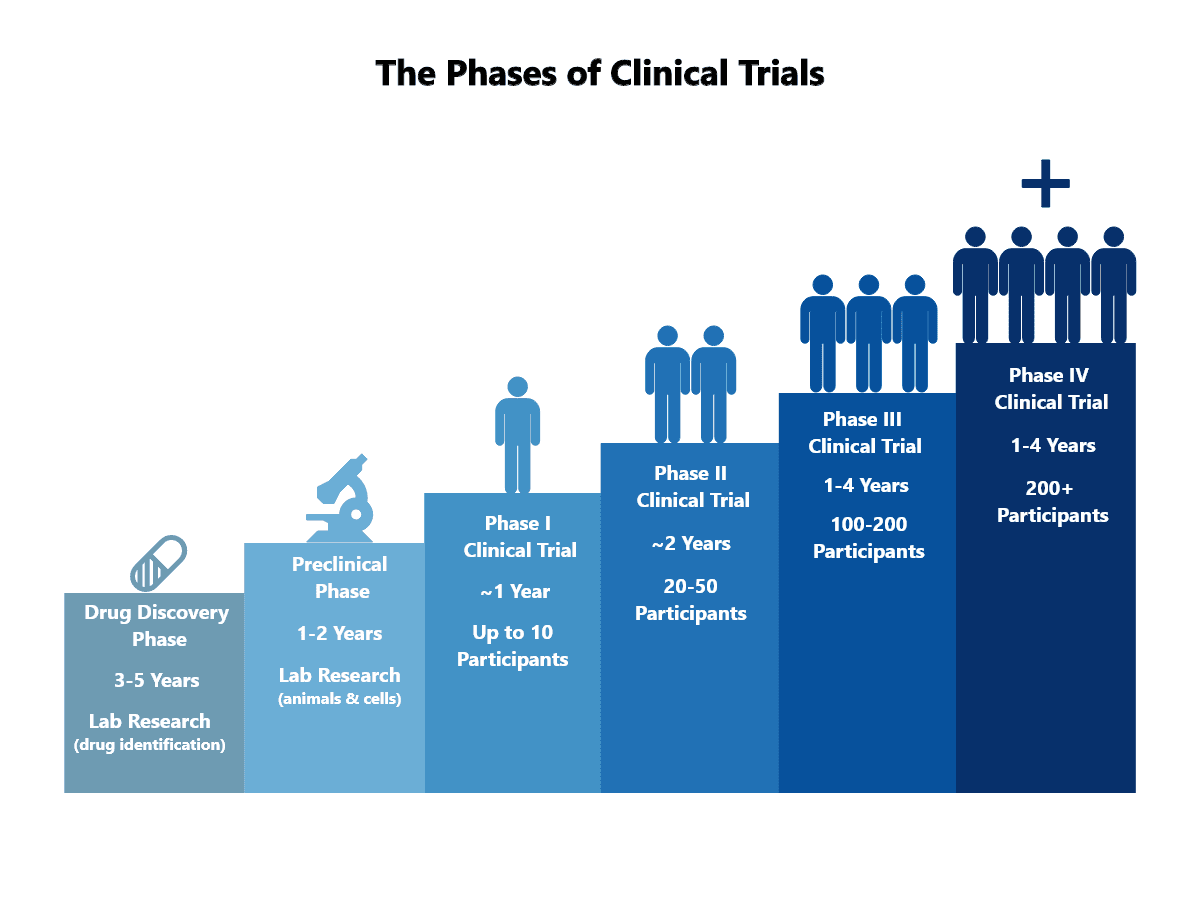
Clinical trials testing potential medical products are commonly classified into four phases. The drug development process will normally proceed through all four phases over many years. If the drug successfully passes through Phases I, II, and III, it will usually be approved by the national regulatory authority for use in the general population. Phase IV trials are 'post-marketing' or 'surveillance' studies conducted to monitor safety over several years.

| Phase | Primary goal | Dose | Patient monitor | Typical number of participants | Success rate* | Notes |
|---|---|---|---|---|---|---|
| Preclinical | Testing of drug in non-human subjects to gather efficacy, toxicity and pharmacokinetic information | Unrestricted | Scientific researcher | No human subjects, in vitro and in vivo only | Includes testing in model organisms. Human immortalized cell lines and other human tissues may also be used. | |
| Phase 0 | Pharmacokinetics; particularly oral bioavailability and half-life of the drug | Small, subtherapeutic | Clinical researcher | 10 people | Often skipped for Phase I. | |
| Phase I | Dose-ranging on healthy volunteers for safety | Often subtherapeutic, but with ascending doses | Clinical researcher | 20-100 normal healthy volunteers (or cancer patients for cancer drugs) | Approx. 52% | Determines whether drug is safe to check for efficacy. |
| Phase II | Testing of drug on participants to assess efficacy and side effects | Therapeutic dose | Clinical researcher | 100-300 participants with a specific disease | Approx. 28.9% | Determines whether drug can have any efficacy; at this point, the drug is not presumed to have any therapeutic effect |
| Phase III | Testing of drug on participants to assess efficacy, effectiveness and safety | Therapeutic dose | Clinical researcher and personal physician | 300-3,000 people with a specific disease | 57.8% | Determines a drug's therapeutic effect; at this point, the drug is presumed to have some effect |
| Phase IV | Post marketing surveillance in public | Therapeutic dose | Personal physician | Anyone seeking treatment from a physician | N/A | Monitor long-term effects |
At the end, let's have an example: Pfizer's vaccine
This example is about a famous and successful clinical trial: Pfizer's SARS-CoV-2 vaccine clinical trial. This trial proved that the vaccine is safe and effective. Now we just want to talk about the number of people in each phase of the trial (sample size).
According to Pfizer:
The study sample size for Phase 1 of the study is not based on any statistical hypothesis testing. Phase 1 comprises 15 participants (randomization ratio of 4:1 so that 12 receive active vaccine and 3 receive placebo) per group; 13 vaccine groups are studied, corresponding to a total of 195 participants.
In phase 2/3 there was 21,999 vaccine recipients randomized in a 1:1 ratio with placebo, for a total sample size of 43,998, based on the assumption of a 1.3% illness rate per year in the placebo group, and 20% of the participants being nonevaluable or having serological evidence of prior infection with SARS-CoV-2, potentially making them immune to further infection. So there was 17,600 evaluable participants per group.
Primary efficacy analysis demonstrates the vaccine to be 95% effective against COVID-19; 170 confirmed cases of COVID-19 were evaluated, with 162 observed in the placebo group versus 8 in the vaccine group.
At the end, phase 4 includes post-marketing studies and monitors the safety of the vaccine.
Sources: wikipedia - Science / wikipedia - Clinical trial / wikipedia - Phases of clinical research / pfizer / pfizer / debraireland / cancergrace
Related Contents
90-90-90 ProgramLet's use "lives with HIV" instead of "infected with HIV"
All Contents Archive